
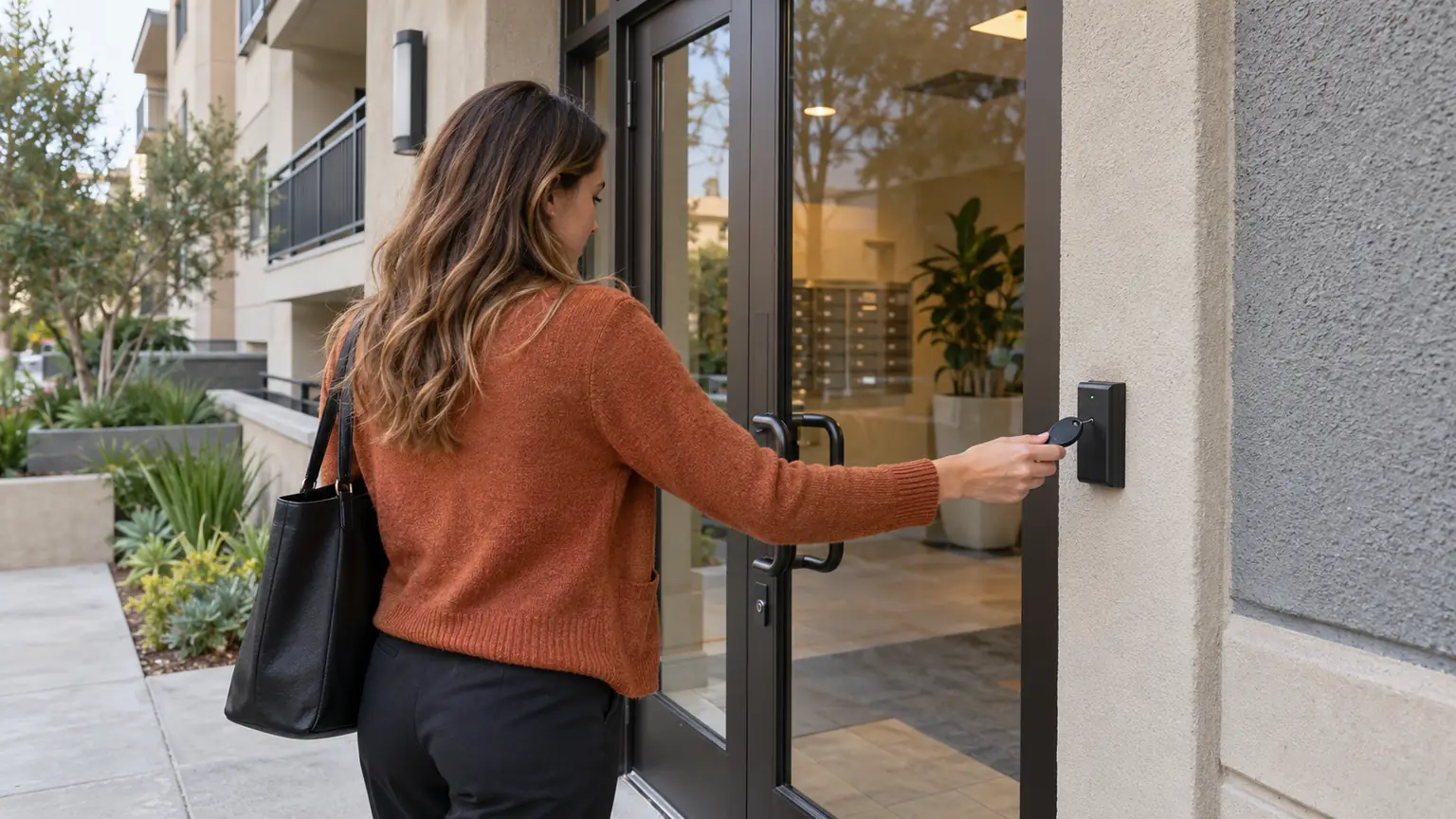
Picture move-in day at a 40-unit apartment building. Three new residents need entrance keys, a maintenance contractor needs access to a mechanical room, and someone reports losing their building fob. Meanwhile, a delivery driver is waiting outside the lobby.
For a property manager, these are not separate security problems. They’re part of the same challenge: controlling who can enter a building, which spaces they can access, and when their permission should end.
That’s where modern apartment access systems become useful.
Keyless entry for apartments uses electronic credentials, such as key fobs, access cards, PIN codes, or smartphones, to control entry without relying entirely on traditional metal keys. In multifamily buildings, these credentials can be managed across shared entrances, amenity rooms, parking areas, and, when supported, individual apartment doors.
The best system isn’t necessarily the one with the most features. It’s the one that fits the property’s layout, resident needs, security requirements, and management workflow.
Why Apartment Buildings Need More Than a Smart Door Lock
Installing a keypad on one apartment door is relatively straightforward. Managing access across an entire residential building is different.
An apartment complex has multiple groups of people with different permissions.
Residents need dependable access to their homes. Maintenance staff may need certain service areas. Visitors require controlled entry, while delivery drivers might need limited access to a package room.
A conventional lock cannot distinguish between these users once they possess the same physical key.
An electronic access control system can assign different permissions to individual credentials, depending on its capabilities.
For example, a resident may have access to the lobby, parking garage, and fitness center, while a cleaning contractor receives access only to designated areas during scheduled hours.
This ability to manage permissions makes multifamily keyless entry different from simply installing a consumer smart lock.
How an Apartment Keyless Entry System Works
Most electronic access systems combine several components.
A reader or electronic lock receives a credential presented by an authorized user.
A controller or integrated lock checks whether that credential has permission to operate the opening.
If access is approved, the system releases the appropriate locking hardware.
Management software may allow authorized staff to add residents, modify permissions, disable credentials, and review supported access records.
Some systems are managed through cloud platforms. Others operate through local controllers or on-premises software.
The distinction matters because network requirements, offline operation, updates, and administrative responsibilities can differ significantly.
An internet connection isn’t necessarily required for every individual door-opening event, but remote management features may depend on connectivity.
Choosing Between Fobs, Keypads, Cards, and Mobile Access
Not every resident wants to use the same entry method.
A practical multifamily access control system should consider how different people enter the building.
| Entry method | Main advantage | Important limitation |
|---|---|---|
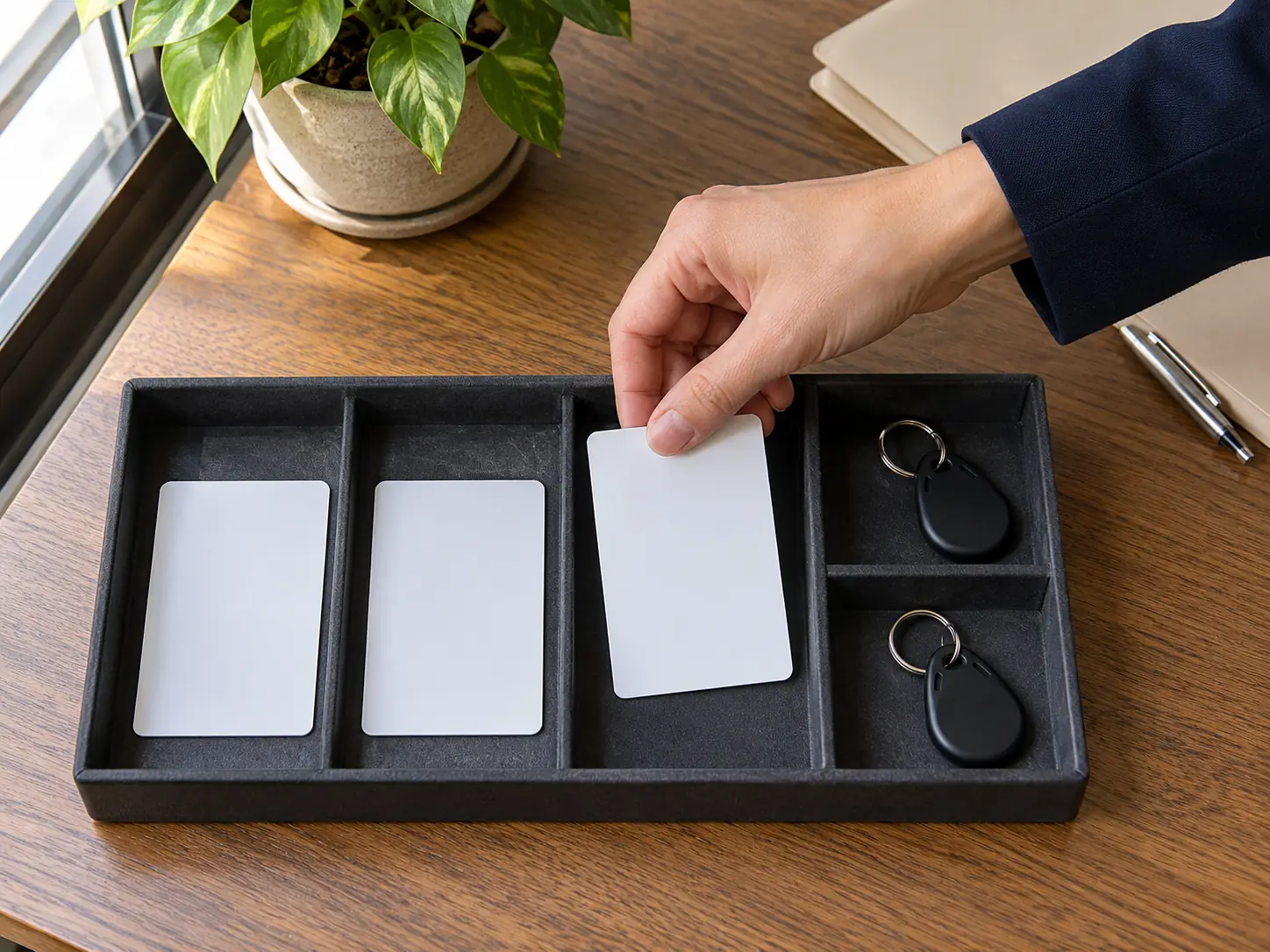
| Key fob | Familiar and convenient | Can be lost or damaged |
| Access card | Easy to issue to authorized users | Requires residents to carry a card |
| PIN keypad | No physical credential required | Shared codes can reduce accountability |
| Mobile credential | Can simplify digital issuance and revocation | Depends on device and system compatibility |
| Video intercom | Supports controlled visitor entry | Requires suitable equipment and management procedures |
These options aren’t mutually exclusive.
A building might offer mobile credentials to residents while retaining physical fobs for people who prefer them.
A visitor intercom can operate alongside either method.
The goal is to select credentials that match actual building operations rather than forcing every user into one access method.
Which Doors Should Be Included in the System?
One of the most important planning decisions is determining where access control belongs.
A property manager might initially focus on the main entrance, but residents move through many shared spaces.
Depending on the property, access points may include:
- Main lobby and secondary entrances.
- Parking garage doors and pedestrian gates.
- Fitness centers and other resident amenities.
- Package rooms and shared storage areas.
- Maintenance rooms and staff-only spaces.
- Individual apartment entrances, when appropriate.
Not every opening needs electronic hardware.
A mechanical lock may remain suitable for certain low-use areas, while high-traffic entrances benefit from centralized credential management.
The decision should reflect security needs, accessibility, existing hardware, and how often permissions change.
The Move-In and Move-Out Process Changes Completely
Traditional key management creates uncertainty during resident turnover.
A departing tenant may return the original key, but property management cannot always know whether copies exist.
Depending on the property’s policies and circumstances, rekeying may be necessary to restore control.
With an appropriately designed electronic system, management can disable a departing resident’s credential and issue new access to the incoming resident.
That process can reduce reliance on physical key exchanges.
However, electronic credential revocation isn’t automatically the same as securing every apartment door.
If a resident also possesses a mechanical key, that credential must be addressed separately.
Similarly, access changes must reach the relevant devices before they can take effect.
A reliable turnover procedure should verify that old permissions have ended and new credentials work correctly.
What Happens When a Resident Loses a Fob or Phone?
Lost credentials are inevitable in a busy residential property.
With a conventional building key, management may face uncertainty about who possesses it.
An electronic system can often disable the missing credential without affecting every other resident.
That is a significant operational advantage.
But the response should include identity verification before issuing a replacement.
Otherwise, someone could impersonate a resident and request access.
Property managers should establish a documented process for reporting lost credentials, confirming identity, disabling access, and issuing replacements.
For smartphone access, the procedure may also need to account for lost devices, changed phone numbers, and account recovery.
Convenience should never replace proper authorization.
Visitor Entry Deserves Its Own Access Plan
Residents aren’t the only people approaching an apartment entrance.
Guests, delivery workers, caregivers, contractors, and prospective tenants all create legitimate visitor-access needs.
A video intercom may allow a resident to identify a visitor and authorize entry.
Other systems support temporary credentials or time-limited permissions.
However, shared permanent entrance codes can become difficult to control.
Once a code is distributed widely, management may not know who still has it.
Temporary or individually assigned credentials can offer better control where the system supports them.
The appropriate method depends on the visitor’s purpose and the building’s security policy.
A delivery driver should not automatically receive the same permissions as a resident.
Why Property Managers Need Different Permission Levels
Centralized access management is useful only when administrative permissions are carefully controlled.
Not every employee needs authority to create credentials or unlock every door.
A leasing employee might need to issue resident credentials, while a maintenance supervisor needs access to service areas.
A system administrator may require broader configuration privileges.
This approach is commonly called role-based access control.
It limits permissions according to responsibilities rather than giving every staff member unrestricted authority.
Management should also review who retains administrative access when employees leave or change roles.
Removing a former employee’s physical key is important, but disabling their software account and electronic credentials matters too.
Can Keyless Apartment Entry Work During an Outage?
An apartment access system must account for both power failures and network interruptions.
The answer depends on the specific equipment.
Some battery-powered locks can continue recognizing stored credentials without an active internet connection.
Other systems rely on building power, controllers, or connected infrastructure.
Backup power may support selected components, but its duration and coverage vary.
Emergency exit requirements are a separate consideration.
A keyless entry installation must preserve code-compliant emergency egress regardless of how residents normally unlock the entrance.
Do not assume every electronically controlled door should automatically unlock during every outage. Requirements depend on the locking arrangement and applicable codes.
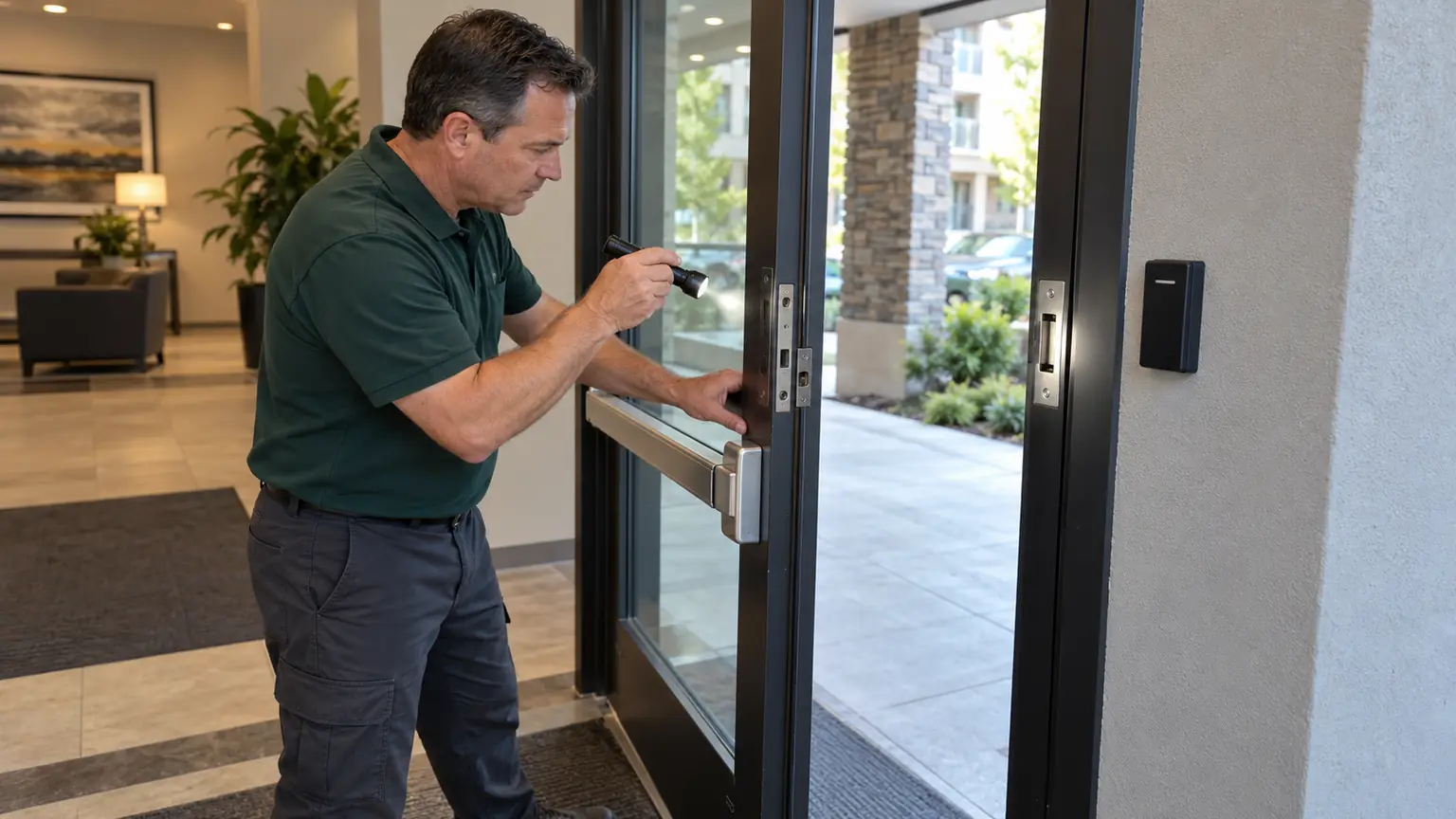
A qualified installer should review power-loss behavior, fire-alarm interfaces, emergency release, and mechanical override provisions where required.
Fire Safety and Accessibility Come Before Convenience
A building entrance must do more than recognize authorized credentials.
It must also operate safely for occupants leaving during an emergency.
Electrified locks, door closers, panic hardware, and access-control readers can interact with fire and life-safety requirements.
The appropriate design depends on the door’s function, building occupancy, and locally adopted regulations.
Accessibility also matters.
Residents and visitors may need entry hardware that can be operated without difficult hand movements or inaccessible controls.
A system that works perfectly in a demonstration may still be unsuitable if its reader is poorly positioned or its door hardware is difficult to operate.
Before installation, confirm the requirements with the relevant authority and qualified professionals.
Should Apartment Owners Choose Cloud-Based Management?
Cloud-based systems can allow authorized managers to update credentials and permissions from supported devices.
That may be useful for properties with multiple buildings or limited on-site staffing.
However, cloud management introduces questions about subscription costs, connectivity, data handling, and vendor dependence.
On-premises systems may offer a different balance of local control and maintenance responsibilities.
Neither architecture is automatically better.
Ask how the system operates when internet access is unavailable, who controls administrator accounts, and what happens if the software provider discontinues a service.
Also confirm whether resident information and entry records can be exported when changing platforms.
What Can Access Logs Actually Tell You?
Many apartment access systems record credential events.
A log might show that a particular fob was accepted at a lobby reader at a certain time.
That can support troubleshooting and authorized security reviews.
However, a credential event doesn’t necessarily prove which person physically entered.
Someone might lend a fob to another individual, or an unauthorized person could follow a resident through an open door.
Logs should therefore be interpreted carefully.
Property managers also need clear policies covering who can view access records, why they may be reviewed, and how long they are retained.
Resident privacy deserves consideration alongside security.
Collecting more data than necessary doesn’t automatically make a building safer.
Retrofitting an Existing Apartment Building
Older multifamily properties may have doors that weren’t designed for electronic access control.
A retrofit begins with evaluating the existing hardware and building conditions.
The installer should inspect door alignment, frames, locksets, closers, electrical pathways, and available power.
A poorly aligned door may remain unreliable even after an expensive reader is installed.
Some openings may accept compatible electronic hardware with limited modification.
Others require more extensive work.
For occupied buildings, installation planning should also address resident notifications, temporary access arrangements, and testing before the old entry method is discontinued.
A phased installation may reduce disruption.
How Much Does Multifamily Keyless Entry Cost?
The cost depends on the size and complexity of the property.
A small building with one shared entrance requires a different scope from a complex with multiple gates, elevators, amenities, and apartment doors.
Major cost factors include hardware compatibility, wiring, door modifications, credential quantities, software subscriptions, installation labor, and ongoing maintenance.
Owners should evaluate the total cost of ownership rather than only the initial equipment price.
For example, a lower installation quote may exclude credential management software or future service costs.
Ask vendors to separate one-time expenses from recurring charges.
That makes proposals easier to compare.
A Practical Checklist Before Selecting a System
Before requesting installation quotes, property managers should document their actual needs.
Start by identifying every door and the people who need access.
Then establish how credentials will be issued, changed, and removed.
Confirm the following:
- Which entrances and shared spaces need electronic control?
- What credential options will residents receive?
- How will visitor and contractor access work?
- What happens during power or network outages?
- Who can manage credentials and review records?
- Does the hardware meet applicable safety and accessibility requirements?
- What maintenance, support, and subscription costs apply?
A clear requirements list makes it easier to compare suitable systems without paying for unnecessary features.
Where a Commercial Locksmith Fits Into the Project
An apartment access-control installation involves more than selecting software.
The door must close, latch, and release correctly.
Electronic credentials must operate compatible locking hardware, and the complete installation must support safe everyday use.
A commercial locksmith can help assess existing doors, recommend appropriate locking arrangements, and identify access-control options within the scope of services offered.
Lock & Key Pros provides commercial access control services involving supported electronic credentials, including cards, codes, and keypads.
The company also works with property managers on approved commercial locksmith services.
For multifamily projects, the first step should be a property-specific evaluation rather than assuming one product fits every entrance.
Frequently Asked Questions
What is the best keyless entry system for an apartment building?
The best option depends on building size, entrance types, resident needs, management requirements, and safety compliance. A combination of fobs, mobile credentials, and visitor entry may be appropriate.
Can apartment managers deactivate a lost key fob?
Many centrally managed systems allow authorized staff to disable individual credentials. The exact process depends on the platform.
Do residents need smartphones for keyless apartment entry?
Not necessarily. Many systems support cards, physical fobs, or PINs alongside mobile credentials.
Can keyless entry be installed in an older apartment building?
Often, yes. Existing door hardware, frames, wiring, accessibility, and code requirements must be evaluated first.
Does apartment keyless entry require internet access?
Not every entry event requires internet connectivity. Offline operation and remote management capabilities depend on the system’s design.
Build an Entry System Around the People Who Use It
A successful apartment access system should make everyday entry dependable while giving management appropriate control over permissions.
That means planning for residents, visitors, staff, turnover, outages, accessibility, and emergency exit requirements from the beginning.
The right solution may involve upgrading only shared entrances or coordinating access across several parts of a multifamily property.
If you’re evaluating keyless entry for apartments, contact Lock & Key Pros to discuss the property’s existing doors, access requirements, and available commercial access-control options.
A professional assessment can help determine which improvements are practical before you commit to a system.
- #keyless entry
- #apartments
- #access control